Showing posts with label FISH. Show all posts

Shrimp

The term shrimp is utilized to allude to some decapod shellfish, despite the fact that the precise creatures secured can differ.

The term shrimp is utilized to allude to some decapod scavangers, despite the fact that the accurate creatures secured can fluctuate. Utilized extensively, it may cover any of the gatherings with lengthened bodies and a principally swimming mode of headway – primarily Caridea and Dendrobranchiata. In a few fields, nonetheless, the term is utilized all the more barely, and may be limited to Caridea, to littler types of either gathering, or to just the marine species. Under the more extensive definition, shrimp may be synonymous with prawn, covering stalk-looked at swimming scavangers with long slender solid tails (guts), long hairs (reception apparatuses) and thin legs. They swim forward by paddling with swimmerets on the underside of their stomach areas. Crabs and lobsters have solid strolling legs, while shrimp have meager delicate legs which they utilize essentially for roosting. Shrimp are across the board and bottomless. They can be discovered encouraging close to the ocean bottom on most drifts and estuaries, and in streams and lakes. To escape predators, a few species flip off the ocean bottom and plunge into the dregs. They normally live from one to seven years. Shrimp are regularly single, however they can structure huge schools amid the generating season. There are a huge number of animal groups, and as a rule there is an animal types adjusted to any specific territory. Any little scavanger which takes after a shrimp has a tendency to be called one. They assume essential parts in the natural way of life and are vital nourishment hotspots for bigger creatures from fish to whales. The solid tails of shrimp can be delightful to eat, and they are generally gotten and cultivated for human utilization. Business shrimp species bolster an industry worth 50 billion dollars a year, and in 2010 the aggregate business creation of shrimp was about 7 million tons (see generation diagram underneath). Shrimp cultivating took off amid the 1980s, especially in China, and by 2007 the harvest from shrimp ranches surpassed the catch of wild shrimp. There are noteworthy issues with exorbitant bycatch when shrimp are caught in the wild, and with contamination harm done to estuaries when they are utilized to bolster shrimp cultivating. Numerous shrimp species are little as the term shrimp recommends, around 2 cm (0.79 in) long, yet some shrimp surpass 25 cm (9.8 in). Bigger shrimp are more inclined to be focused on financially, and are regularly alluded to as prawns, especially in Britain.

Shrimp are swimming scavangers with long thin strong guts and long radio wires. Not at all like crabs and lobsters, shrimp have decently created pleopods (swimmerets) and slim strolling legs; they are more adjusted for swimming than strolling. Truly, it was the refinement in the middle of strolling and swimming that structured the essential taxonomic division into the previous suborders Natantia and Reptantia. Individuals from the Natantia (shrimp in the more extensive sense) were adjusted for swimming while the Reptantia (crabs, lobsters, and so forth.) were adjusted for creeping or walking.[9] Some different gatherings additionally have regular names that incorporate "shrimp"; any little swimming shellfish taking after a shrimp has a tendency to be called one.


There are numerous varieties in the ways diverse sorts of shrimp look and carry on. Indeed inside the center gathering of caridean shrimp, the little sensitive Pederson's shrimp (above) looks and acts very not at all like the vast business pink shrimp or the snapping gun shrimp. The caridean group of gun shrimp are portrayed by huge unbalanced paws, the bigger of which can deliver an uproarious snapping sound. The family is different and worldwide in dispersion, comprising of around 600 species. States of snapping shrimp are a real wellspring of clamor in the sea and can meddle with sonar and submerged correspondence. The little head shrimp has an advantageous association with ocean slugs and ocean cucumbers, and may help keep them clear of ectoparasites.


Continue Reading...

CRAB.

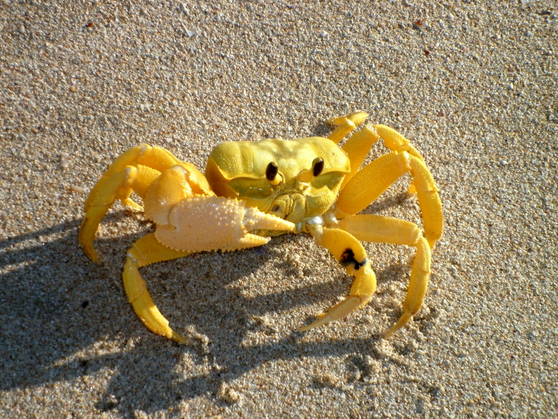
Crabs are decapod shellfish of the infraorder Brachyura, which regularly have a short anticipating "tail", for the most part completely covered up under the thorax.

Crabs are decapod scavangers of the infraorder Brachyura, which commonly have a short anticipating "tail" (stomach area) (Greek: βραχύς/ brachys = short, οὐρά/ οura = tail), generally totally covered up under the thorax. They live in all the world's seas, in new water, and ashore, are by and large secured with a thick exoskeleton and have a solitary pair of hooks. Numerous different creatures with comparable names –, for example, loner crabs, ruler crabs, porcelain crabs, horseshoe crabs and crab lice – are no.


Crabs are by and large secured with a thick exoskeleton, made fundamentally out of calcium carbonate, and outfitted with a solitary pair of chelae (paws). Crabs are found in the greater part of the world's seas, while numerous crabs live in new water and ashore, especially in tropical areas. Crabs shift in size from the pea crab, a couple of millimeters wide, to the Japanese insect crab, with a leg compass of up to 4 meters (13 ft). Around 850 types of crab are freshwater, physical or semi-physical species; they are found all through the world's tropical and semi-tropical districts. They were already thought to be a monophyletic gathering, yet are currently accepted to speak to no less than two particular heredities, one in the Old World and one in the New World. The most punctual unambiguous crab fossils date from the Jurassic, albeit Carboniferous Imocaris, known just from its carapace, may be a primitive crab. The radiation of crabs in the Cretaceous and subsequently may be connected either to the separation of Gondwana or to the simultaneous radiation of hard fish, crabs' primary predators.


Crabs frequently show checked sexual dimorphism. Guys regularly have bigger hooks, a propensity which is especially declared in the fiddler crabs of the class Uca (Ocypodidae). In fiddler crabs, guys have one paw which is enormously augmented and which is utilized for correspondence, especially for drawing in a mate. Another obvious distinction is the type of the pleon (guts); in most male crabs, this is tight and triangular in structure, while females have a more extensive, adjusted belly. This is because of the way that female crabs brood treated eggs on their pleopods.


Continue Reading...

Lobster

Torn lobsters contain a group of vast marine shellfish. They have long bodies with solid tails, and live in cleft or tunnels on the ocean bottom.

Mauled lobsters contain a family (Nephropidae, infrequently likewise Homaridae) of extensive marine scavangers. They have long bodies with strong tails, and live in hole or tunnels on the ocean bottom. Three of their five sets of legs have paws, including the first match, which are normally much bigger than the others. Profoundly prized as fish, lobsters are financially critical, and are regularly a standout amongst the most beneficial things in beachfront ranges they populate. Economically vital species incorporate two types of Homarus from the northern Atlantic Ocean, and scampi – the northern-side of the equator variety Nephrops and the southern-half of the globe sort Metanephrops. Albeit a few different gatherings of scavangers have "lobster" in their names, the inadequate term "lobster" by and large alludes to the mauled lobsters of the family Nephropidae. Clawed lobsters are not nearly identified with prickly lobsters or shoe lobsters, which have no paws (chelae), or to squat lobsters. The nearest living relatives of mauled lobsters are the reef lobsters and the three groups of freshwater crayfis.

Lobsters are spineless creatures with a hard defensive exoskeleton. Like most arthropods, lobsters must shed so as to develop, which abandons them helpless. Amid the shedding process, a few species change shading. Lobsters have 10 strolling legs; the front three sets bear hooks, the first of which are bigger than the others. Albeit, in the same way as most different arthropods, lobsters are to a great extent reciprocally symmetrical, some genera have unequal, particular hooks. Lobster life systems incorporates the cephalothorax which intertwines the head and the thorax, both of which are secured by a chitinous carapace, and the guts. The lobster's head bears radio wires, antennules, mandibles, the first and second maxillae, and the to begin with, second, and third maxillipeds. Since lobsters live in a cloudy domain at the base of the sea, they for the most part utilize their reception apparatuses as sensors. The lobster eye has an intelligent structure over a curved retina. Conversely, most complex eyes use refractive beam concentrators (lenses) and an inward retina. The mid-region incorporates swimmerets and its tail is made out of uropods and the telson. Lobsters, in the same way as snails and insects, have blue blood because of the vicinity of hemocyanin which contains copper. Interestingly, vertebrates and numerous different creatures have red blood from iron-rich hemoglobin. Lobsters have a green hepatopancreas, called the tomalley by culinary specialists, which works as the creature's liver and pancreas.


It has been evaluated that lobsters experience 70 years old,although deciding age is troublesome. In 2012 a report was distributed depicting how development groups in calcified locales of the eyestalk or gastric plant in shrimps, crabs, and lobsters could be utilized to quantify development and mortality in decapod scavangers. Without such a method, a lobster's age is assessed by size and different variables; this new learning "could help researchers better comprehend the populace and support controllers of the lucrative business". Exploration recommends that lobsters may not ease off, debilitate, or lose ripeness with age, and that more established lobsters may be more prolific than more youthful lobsters. This life span may be because of telomerase, a compound that repairs long monotonous areas of DNA successions at the closures of chromsomes, alluded to as telomeres. Telomerase is communicated by most vertebrates amid embryonic stages however is by and large missing from grown-up phases of life. Be that as it may, dissimilar to most vertebrates, lobsters express telomerase as grown-ups through most tissue, which has been proposed to be identified with their life span. Lobster life span is constrained by their size. It requires metabolic vitality to shed and the bigger the lobster the more vitality required; 10 to 15% of lobsters pass on of depletion amid shedding, while in more established lobsters shedding stops and the exoskeleton debases or falls altogether prompting demise. Lobsters, in the same way as other decapod scavangers, develop all through life, and have the capacity to include new muscle cells at every shed. Lobster life span permits them to achieve noteworthy sizes. As per Guinness World Records, the biggest lobster ever got was in Nova Scotia, Canada, measuring 20.15 kilograms (44.4 lb).


Continue Reading...

Sea urchin

Ocean urchins or urchins, obsoletely called ocean hedgehogs, are little, sharp, globular creatures that, with their nearby family, for example, sand dollars, constitute the class Echinoidea of the echinoderm phylum.

Ocean urchins or urchins (/ˈərtʃɪnz/), anciently called ocean hedgehogs, are little, prickly, globular creatures that, with their nearby kinfolk, for example, sand dollars, constitute the class Echinoidea of the echinoderm phylum. Around 950 types of echinoids possess all seas from the intertidal to 5000 m profound. The shell, or "test", of ocean urchins is round and barbed, ordinarily from 3 to 10 cm (1.2 to 3.9 in) over. Regular hues incorporate dark and dull shades of green, olive, chestnut, purple, blue, and red. Ocean urchins move gradually, and feast upon generally green growth. Ocean otters, starfish, wolf eels, triggerfish, and different predators chase and eat ocean urchins. Their roe is a delicacy in numerous cooking styles. The name "urchin" is an old word for hedgehog, which ocean urchins take off.

Ocean urchins are individuals from the phylum Echinodermata, which additionally incorporates ocean stars, ocean cucumbers, weak stars, and crinoids. Like different echinoderms, they have five-fold symmetry (called pentamerism) and move by method for several modest, straightforward, cement "tube feet". The symmetry is not evident in the living creature, however is effortlessly noticeable in the dried test. In particular, the expression "ocean urchin" alludes to the "consistent echinoids", which are symmetrical and globular, and incorporates a few diverse taxonomic gatherings, including two subclasses : Euechinoidea ("advanced" ocean urchins, including sporadic ones) and Cidaroidea or "slate-pencil urchins", which have thick, limit spines, with green growth and wipes developing on it. The unpredictable ocean urchins are an infra-classis inside the Euechinoidea, called Irregularia, and including Atelostomata and Neognathostomata. "Unpredictable" echinoids include: leveled sand dollars, ocean bread rolls, and heart urchins. Together with ocean cucumbers (Holothuroidea), they make up the subphylum Echinozoa, which is described by a globoid shape without arms or anticipating beams. Ocean cucumbers and the sporadic echinoids have optionally advanced different shapes. Albeit numerous ocean cucumbers have spread appendages encompassing their oral openings, these have started from adjusted tube feet and are not homologous to the arms of the crinoids, ocean stars, and weak stars.

Like different echinoderms, ocean urchins are bilaterans. Their initial hatchlings have two-sided symmetry, yet they build up fivefold symmetry as they develop. This is most clear in the "general" ocean urchins, which have generally round bodies, with five similarly estimated parts transmitting out from their focal tomahawks. A few ocean urchins, then again, including the sand dollars, are oval fit as a fiddle, with particular front and backsides, issuing them a level of two-sided symmetry. In these urchins, the upper surface of the body is marginally domed, however the underside is level, while the sides are without tube feet. This "unpredictable" body structure has advanced to permit the creatures to tunnel through sand or other delicate materials.


Continue Reading...

SHARK

Sharks are a gathering of fish described by a cartilaginous skeleton, five to seven gill openings on the sides of the head, and pectoral blades that are not combined to the head.

Sharks are a gathering of fish described by a cartilaginous skeleton, five to seven gill openings on the sides of the head, and pectoral blades that are not melded to the head. Current sharks are ordered inside the clade Selachimorpha (or Selachii) and are the sister gathering to the beams. On the other hand, the expression "shark" has likewise been utilized for terminated individuals from the subclass Elasmobranchii outside the Selachimorpha, for example, Cladoselache and Xenacanthus, and in addition different Chondrichthyes, for example, the holocephalid eugenedontidans. Under this more extensive definition, the soonest known sharks go back to more than 420 million years ago.Acanthodians are regularly alluded to as "barbed sharks"; however they are not piece of Chondrichthyes fitting, they are a paraphyletic gathering prompting cartilaginous fish overall. From that point forward, sharks have differentiated into more than 500 species. They go in size from the little diminutive person lanternshark (Etmopterus perryi), a remote ocean types of just 17 centimeters (6.7 in) long, to the whale shark (Rhincodon typus), the biggest fish on the planet, which comes to give or take 12 meters (39 ft) long. Sharks are found in all oceans and are regular to profundities of 2,000 meters (6,600 ft). They for the most part don't live in freshwater albeit there are a couple of referred to exemptions, for example, the bull shark and the waterway shark, which can survive and be found in both seawater and freshwater.They inhale through five to seven gill openings. Sharks have a covering of dermal denticles that shields their skin from harm and parasites notwithstanding enhancing their liquid motion. They have a few arrangements of replaceable teeth.

Until the sixteenth century,sharks were referred to sailors as "ocean mutts". The historical background of "shark" is indeterminate. One hypothesis is that it gets from the Yucatec Maya word xok, affirmed 'shok'. Proof for this derivation originates from the Oxford English Dictionary, which notes shark first came into utilization after Sir John Hawkins' mariners showed one in London in 1569 and posted "sharke" to allude to the substantial sharks of the Caribbean Sea. Notwithstanding, the Middle English Dictionary records a secluded event of the word shark (alluding to an ocean fish) in a letter composed by Thomas Beckington in 1442, which discounts a New World historical background. An other historical background expresses that the first feeling of the word was that of "predator, one who preys on others" from the German Schorck, a variation of Schurke "scalawag, rapscallion" (cf. card shark, advance shark, and so on.), which was later connected to the fish because of its ruthless conduct.

Proof for the presence of sharks dates from the Ordovician period, 450–420 million years prior, before area vertebrates existed and before numerous plants had colonized the mainlands. Just scales have been recuperated from the first sharks and not all scientistss concur that these are from genuine sharks, suspecting that these scales are really those of thelodont agnathans. The most established by and large acknowledged shark scales are from around 420 million years back, in the Silurian period. The principal sharks looked altogether different from current sharks. The lion's share of advanced sharks can be followed back to around 100 million years prior. Most fossils are of teeth, regularly in huge numbers. Fractional skeletons and even finish fossilized remains have been found. Assessments recommend that sharks develop countless teeth over a lifetime, which clarifies the inexhaustible fossils. The teeth comprise of effectively fossilized calcium phosphate, an apatite. At the point when a shark kicks the bucket, the deteriorating skeleton separates, dissipating the apatite crystals. Protection obliges quick internment in base dregs. Among the most old and primitive sharks is Cladoselache, from around 370 million years prior, which has been found inside Paleozoic strata in Ohio, Kentucky, and Tennessee. By then in Earth's history these stones made up the delicate base dregs of an expansive, shallow sea, which extended crosswise over quite a bit of North America. Cladoselache was just around 1 meter (3.3 ft) long with hardened triangular balances and thin jaws.Its teeth had a few pointed cusps, which wore down from utilization. From the little number of teeth discovered together, it is doubtlessly that Cladoselache did not supplant its teeth as routinely as advanced sharks. Its caudal balances had a comparable shape to the immense white sharks and the pelagic shortfin and longfin makos. The vicinity of entire fish orchestrated tail-first in their stomachs propose that they were quick swimmers with awesome nimblenes.


Continue Reading...

GIANT BARB.

The goliath thorn or Siamese monster carp, Catlocarpio siamensis, is the biggest types of cyprinid on the planet. These transient fish are discovered just in the Mae Klong, Mekong and Chao Phraya stream bowls in Indochina.

They are generally seen in the enormous pools along the edges of vast streams, yet will occasionally enter littler trenches, floodplains and overflowed woodlands. Youthful spikes are typically found in littler tributaries and bogs, yet can adjust to living in lakes, channels and swamps.The angle for the most part live in sets. These are transitory fish, swimming to positive ranges for sustaining and reproducing in distinctive parts of the year.These moderate moving fish subsist on green growth, phytoplankton and products of immersed physical plants, once in a while (if at any point) bolstering on dynamic creatures. In the lower Mekong bowl, youthful goliath thorns have been accounted for as happening essentially in October.

The head is somewhat vast for the body. There are no barbels. The titan thorn positions among the biggest freshwater fish on the planet, and is likely the biggest fish in the family Cyprinidae. It may achieve 3 m (9.8 ft) (in spite of the fact that this guaranteed most extreme length needs affirmation) and weigh up to 300 kg (660 lb). Among the cyprinids, just the brilliant mahseer can achieve a practically identical length, yet it is a generally slim fish that weighs far less. Couple of substantial goliath points are gotten today. Case in point, no individual measuring more than 150 kg (330 lb) has been gotten in Cambodia since 1994.[1] Today the greatest length is around 1.8 m (6 ft). This fish is really tetraploid, significance it has four of every chromosome (instead of diploid, the ordinary number in creatures).


The principle dangers are from living space misfortune (e.g., contamination and dams) and overfishing. The sharp populace decay is decently outlined by catch information from Cambodia, where 200 tons of monster thorns were gotten in 1964. By 1980, just around 50 fish were gotten and by 2000, just 10. It was once in the past an imperative fish in nearby gets underneath the Khone Phapheng Falls, yet reviews somewhere around 1993 and 1999 just found a solitary little single person. Hence, the titan thorn is recorded as Critically Endangered on the IUCN Red List. It has been altogether extirpated from the Chao Phraya River. In a 2005 imperial announcement, the Kingdom of Cambodia assigned this fauna as the national fish to convey preservation attention to this species.


Continue Reading...

Jellyfish

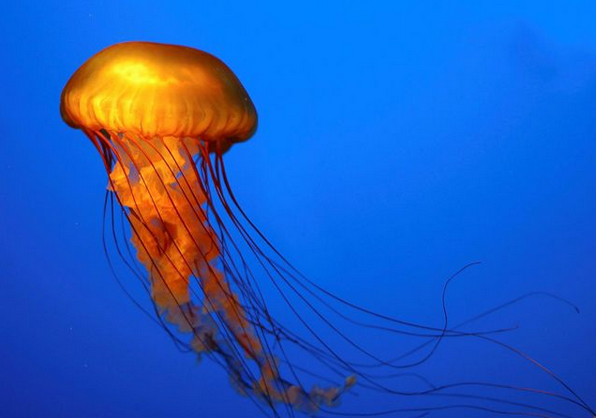
Jellyfish or jellies are the major non-polyp form of individuals of the phylum Cnidaria. They are typified as free-swimming marine animals consisting of a gelatinous umbrella-shaped bell and trailing tentacles.

Jellyfish or jams are the major non-polyp manifestation of people of the phylum Cnidaria. They are embodied as free-swimming marine creatures comprising of a coagulated umbrella-molded ringer and trailing arms. The chime can throb for movement, while stinging arms can be utilized to catch prey. Jellyfish are found in every sea, from the surface to the remote ocean. Scyphozoans are only marine, yet a few hydrozoans live in freshwater. Huge, regularly brilliant, jellyfish are normal in beachfront zones around the world. Jellyfish have meandered the oceans for no less than 500 million years, and perhaps 700 million years or additionally, making them the most established multi-organ creature.

The English prominent name jellyfish has been being used following 1796. It has customarily additionally been connected to different creatures imparting a shallow likeness, for instance ctenophores (individuals from another phylum of regular, thick and for the most part straightforward or translucent, free-swimming planktonic carnivores now known as brush jams) were incorporated as "jellyfishes". Indeed a few researchers incorporate the phylum ctenophora when they are alluding to jellyfish. Different researchers want to utilize the all the more comprehensive term coagulated zooplankton, when alluding to these, together with other delicate bodied creatures in the water section. As jellyfish are not genuine fish (which are vertebrates, dissimilar to jellyfish), the word jellyfish is considered by some to be a misnomer. Open aquariums may utilize the terms jams or ocean jams instead.The term "jams" may have ended up more mainstream than "jellyfish". In logical writing, "jam" and "jellyfish" are regularly utilized reciprocally. A few sources may utilize the expression "jam" to allude to living beings in this taxon, as "jellyfish" may be viewed as wrong. Numerous course readings and sources allude to just scyphozoa as "genuine jellyfish". A gathering of jellyfish is in some cases called a blossom or a swarm. "Sprout" is typically utilized for an expansive gathering of jellyfish that assemble in a little territory, however might likewise have a period part, alluding to occasional builds, or numbers past what was normal. Another aggregate name for a gathering of jellyfish is a smack,despite the fact that this term is not ordinarily utilized by researchers who study jellyfish. Jellyfish are "bloomy" by nature of their life cycles, being created by their benthic polyps typically in the spring when daylight and tiny fish expand, so they show up rather all of a sudden and regularly in substantial numbers, actually when a biological community is in offset. Utilizing "swarm" as a rule infers a dynamic capacity to stay together, which a couple of animal categories, for example, Aurelia, the moon jam, illustrate. Medusa jellyfish may be named scyphomedusae ("genuine" jellyfish), stauromedusae (stalked jellyfish), cubomedusae (box jellyfish), or hydromedusae, as per which clade their species has a place. The term medusa was begat by Linnaeus in 1752, implying the tentacled head of Medusa in Greek mythology. This term alludes only to the non-polyp life-stage which happens in numerous cnidarians, which is encapsulated by an extensive throbbing thick ringer with long trailing appendages. All medusa-delivering species fit in with the sub-phylum Medusozoa.

Jellyfish utilize a free system of nerves, situated in the epidermis, which is known as a "nerve net". Albeit generally thought not to have a focal sensory system, nerve net focus and ganglion-like structures could be considered to constitute one in many animal categories. A jellyfish recognizes different boosts including the touch of different creatures by means of this nerve net, which then transmits motivations both all through the nerve net and around a roundabout nerve ring, through the rhopalial lappet, situated at the edge of the jellyfish body, to other nerve cells. A few animal varieties unequivocally adjust to tidal flux. In Roscoe Bay, jellyfish ride the momentum at ebb tide until they hit a rock bar, and after that dive underneath the flow. They stay in still waters until the tide rises, climbing and permitting it to breadth them over into the sound. They additionally effectively stay away from new water from mountain snowmelt, plunging until they sufficiently discover salt.


Continue Reading...

DOLPHIN.

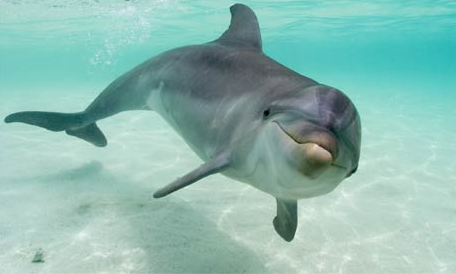
Dolphins are cetacean warm blooded animals nearly identified with whales and porpoises. There are right around forty types of dolphin in 17 genera. They differ in size from 1.2 m and 40 kg, up to 9.5 m and 10 tons.

The name is initially from Greek δελφίς (delphís), "dolphin", which was identified with the Greek δελφύς (delphus), "womb". The creature's name can hence be translated as signifying "a "fish" with a womb". The name was transmitted by means of the Latin delphinus (the romanization of the later Greek δελφῖνος – delphinos), which in Medieval Latin got to be dolfinus and in Old French daulphin, which reintroduced the ph into the word. The term mereswine (that is, "ocean pig") has likewise truly been utilized. The expression "dolphin" can be utilized to allude to, under the suborder Odontoceti, all the species in the family Delphinidae (marine dolphins including orcas and pilot whales) and the stream dolphin families Iniidae (South American waterway dolphins), Pontoporiidae (La Plata dolphin), Lipotidae (Yangtze stream dolphin) and Platanistidae (Ganges waterway dolphin and Indus waterway dolphin). This term has regularly been abused in the US, mostly in the angling business, where all little cetaceans (dolphins and porpoises) are considered porpoises, while the fish dorado is called dolphin fish.In regular use the expression "whale" is utilized just for the bigger cetacean species, while the littler ones with a hooked or more nose are considered 'dolphins'. The name "dolphin" is utilized calmly as an equivalent word for bottlenose dolphin, the most widely recognized and commonplace types of dolphin.Killer whales likewise have a place with the family Delphinidae and accordingly qualify as dolphins. Despite the fact that the expressions "dolphin" and "porpoise" are at times utilized conversely, porpoises are not considered dolphins and have distinctive physical highlights, for example, a shorter bill and spade-formed teeth; they additionally vary in their conduct. Porpoises have a place with the family Phocoenidae and offer a typical lineage with the Delphinidae. A gathering of dolphins is known as a "school" or a "case". Male dolphins are called "bulls", females "dairy animals" and youthful dolphin.

Alongside whales and porpoises, dolphins are relatives of physical warm blooded animals, probably of the Artiodactyl request. The predecessors of the cutting edge dolphins entered the water around 55 million years back, in the Eocene age. Rear appendage buds are obvious on a fetus of a seen dolphin in the fifth week of advancement as little knocks (rear appendage buds) close to the base of the tail. The pin is give or take 2.5 cm (1 in) long. Advanced dolphin skeletons have two little, pole molded pelvic bones thought to be minimal rear appendages. In October 2006, a strange bottlenose dolphin was caught in Japan; it had little blades on every side of its genital opening, which researchers accept to be a strangely claimed advancement of these minimal rear appendages.


Dolphins have a streamlined fusiform body, adjusted for quick swimming. The tail blade, called the fluke, is utilized for drive while the pectoral blades, together with the whole tail segment, give directional control. The dorsal balance, in those species that have one, gives dependability while swimming. In spite of the fact that fluctuating by species, essential hue examples are shades of dim, as a rule with a lighter underside and frequently with lines and patches of diverse tone and difference. The head contains the melon, a round organ utilized for echolocation. In numerous species, prolonged jaws structure a particular mouth; animal categories, for example, the bottlenose have a bended mouth which resembles an altered grin. A few animal varieties have up to 250 teeth. Dolphins inhale through a blowhole on top of their head. The trachea is front to the cerebrum. The dolphin mind is huge and exceedingly complex, and is distinctive in structure from that of most land warm blooded creatures. Dissimilar to most vertebrates, dolphins don't have hair, with the exception of a couple of hairs around the tip of their platform (nose) which they lose quickly before or after birth.The just special case to this is the Boto stream dolphin, which has constant little hairs on the platform.


Continue Reading...

OCTOPUS

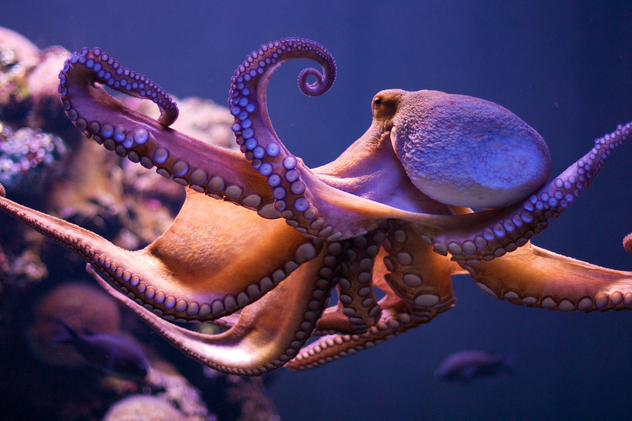
An octopus is a cephalopod mollusc of the request Octopoda. It has two eyes and four sets of arms and, in the same way as different cephalopods, it is respectively symmetric. An octopus has a hard nose, with its mouth at the inside purpose of the arms.

An octopus (/ˈɒktəpʊs/ or/ˈɒktəpəs/; plural: octopuses, octopi, or octopodes; see beneath) is a cephalopod mollusc of the request Octopoda. It has two eyes and four sets of arms and, in the same way as different cephalopods, it is respectively symmetric. An octopus has a hard snout, with its mouth at the inside purpose of the arms. An octopus has no inner or outer skeleton (albeit a few species have a minimal remainder of a shell inside their mantles), permitting it to press through tight places. Octopuses are among the most wise and behaviorally adaptable of all spineless creatures. Octopuses occupy numerous different areas of the sea, including coral reefs, pelagic waters, and the sea floor. They have various techniques for shielding themselves against predators, including the removal of ink, the utilization of cover and deimatic showcases, their capacity to stream rapidly through the water, and their capacity to stow away. An octopus trails its eight arms behind it as it swims. All octopuses are venomous, however stand out gathering, the blue-ringed octopus, is known to be savage to people. Around 300 species are perceived, which is more than 33% of the aggregate number of known cephalopod species. The expression "octopus" might likewise be utilized to allude particularly to the family .

Octopuses are described by their eight arms, generally bearing suction mugs. The arms of octopuses are frequently recognized from the pair of bolstering appendages found in squid and cuttlefish. Both sorts of appendage are strong hydrostats. Not at all like most different cephalopods, the larger part of octopuses – those in the suborder most generally known, Incirrina – have totally delicate bodies with no inner skeleton. They have neither a defensive external shell like the nautilus, nor any remnant of an interior shell or bones, in the same way as cuttlefish or squid. The bill, comparable fit as a fiddle to a parrot's mouth, and made of chitin, is the main critical issue of their bodies. This empowers them to crush through exceptionally limited openings between submerged rocks, which is extremely useful when they are escaping from moray eels or other ruthless fish. The octopuses in the less-recognizable Cirrina suborder have two balances and an inward shell, by and large diminishing their capacity to crush into little spaces. These cirrate species are frequently free-swimming and live in profound water territories, while incirrate octopus species are found in reefs and other shallower ocean bottom living spaces. Octopuses have a generally short future, with a few species living for as meager as six months. Bigger species, for example, the goliath pacific octopus, may live for up to five years under suitable circumstances. In any case, proliferation is a reason for death: guys can live for just a couple of months in the wake of mating, and females bite the dust soon after their eggs hatch. They disregard to eat amid the (around) one-month period spent dealing with their unhatched eggs, inevitably biting the dust of starvation. In an exploratory test, the evacuation of both optic organs in the wake of generating was found to result in the end of broodiness, the resumption of bolstering, expanded development, and significantly amplified lifespans. Grimpoteuthis discoveryi, a finned octopus of the suborder Cirrina Octopuses have three hearts. Two branchial hearts pump blood through each of the two gills, while the third is a systemic heart that pumps blood through the body. Octopus blood contains the copper-rich protein hemocyanin for transporting oxygen. Albeit less proficient under typical conditions than the iron-rich hemoglobin of vertebrates, in chilly conditions with low oxygen weight, hemocyanin oxygen transportation is more productive than hemoglobin oxygen transportation. The hemocyanin is broken up in the plasma as opposed to being conveyed inside red platelets, and gives the blood a somewhat blue shading. The octopus draws water into its mantle cavity, where it goes through its gills. As molluscs, their gills are finely partitioned and vascularized outgrowths of either the external or the internal body surf


The monster Pacific octopus, Enteroctopus dofleini, is regularly refered to as the biggest octopus species. Grown-ups as a rule weigh around 15 kg (33 lb), with an arm compass of up to 4.3 m (14 ft). The biggest example of this species to be logically reported was a creature with a live mass of 71 kg (156.5 lb). The option contender is the seven-arm octopus, Haliphron atlanticus, taking into account a 61 kg (134 lb) body assessed to have a live mass of 75 kg (165 lb). However, various faulty size records would recommend E. dofleini is the biggest of all octopus species by a significant margin; one such record is of an example measuring 272 kg (600 lb) and having an arm compass of 9 m (30 ft).


Continue Reading...

Followers

Popular Posts